
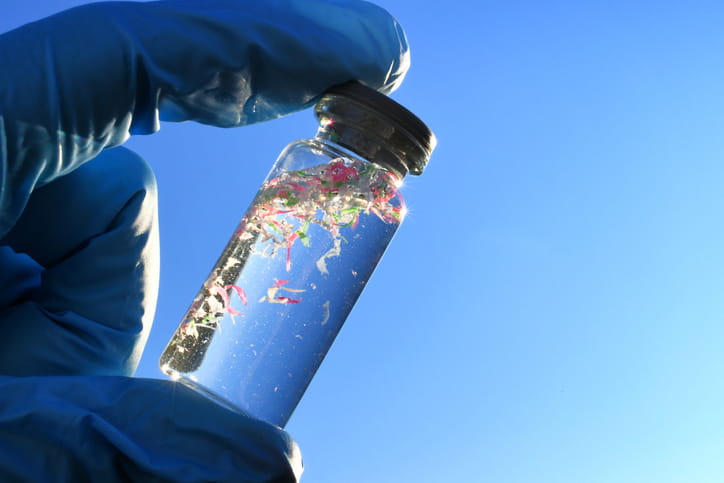
Microplastics are drawing increasing attention from scientists, regulators, and the public as researchers document the potential impact these tiny particles have on the human body. A 2025 study published in Nature Medicine found microplastics accumulating in human brain tissue, with concentrations in 2024 samples roughly 50 percent higher than 2016 samples. Follow-on coverage in outlets such as The Washington Post has amplified public concern, while federal agencies are working to better understand and address the many ways people may be exposed to microplastics.
Before regulators can set limits on microplastics in drinking water, they first have to answer a surprisingly difficult question: What exactly is a microplastic?
Brent Alspach, PE, Director of Applied Research at Arcadis engineering consulting firm, discussed the challenges of defining microplastics at the American Water Works Association’s ACE26 conference, one of the water industry’s premier, annual gatherings. He emphasized that the definition will be critical in determining how regulatory agencies ultimately approach oversight and limits.
“It’s complicated,” Alspach said, noting that a fit-for-purpose definition of microplastics in drinking water may differ from definitions used in wastewater or other environmental contexts. “It’s complicated to describe what microplastics actually are.”
And that complexity extends beyond semantics. The definition, or multiple definitions, could evolve over time as science advances and measurement capabilities improve.
Recent federal activity underscores just how quickly this field is developing.
Last month, the U.S. Environmental Protection Agency (EPA) and U.S. Department of Health and Human Services (HHS) announced a massive undertaking to better understand how microplastics are affecting human health and how to regulate them. The EPA, specifically, is considering adding microplastics to the agency’s draft Sixth Contaminant Candidate List for Drinking Water and recently closed a public comment period that received more than 14,000 comments. Separately, HHS has announced a $144 million investment in the STOMP initiative- Systematic Targeting of MicroPlastics – a phased research program designed to identify where microplastics are going in our bodies and to determine which types are the most harmful.
Taken together, these actions reflect a growing federal focus on both defining and understanding microplastics before formal regulatory thresholds are established.
At a basic level, microplastics are tiny – often microscopic – particles of plastic. But what is the morphology of these tiny particles – their type and size - and what will be their impact on our health. Those are among the factors state and federal governments will consider as they work toward official regulation.
Before enforceable limits can be established, researchers and policymakers must also agree on validated analytical methods capable of consistently detecting, identifying and quantifying microplastics in drinking water. Those methods will need rigorous quality controls to ensure data accuracy and precision, Alspach said.
Some jurisdictions have already begun laying the groundwork. California addressed the issue in 2018 through SB1422, which requires the state to establish a definition and standardized testing methods for microplastics in drinking water, followed by a mandatory four-year testing and public reporting program. The bill directed the California State Water Resources Control Board to implement these standards in a phased approach.
Internationally, efforts are also underway. The European Union and ASTM International (formerly the American Society for Testing and Materials) have also developed definitions for microplastics, but ASTM is not specific to drinking water.
The work to define, regulate, and protect public health from microplastics is just beginning. There is an enormous body of research already available with additional studies underway.
As awareness grows around the presence of plastic particles in the environment and in the human body, so too will the demand for clear, science-based regulatory frameworks. This balance between science, infrastructure, and public trust is already shaping how the industry responds. As DIPRA noted following the recent EPA and HHS announcements:
“Public confidence in drinking water depends on trust, in both the quality of the water itself and the integrity of the systems that deliver it. As researchers work to define what microplastics are doing to us, communities deserve to know what their pipes are made of. The science is catching up, the known and unknown risks continue to increase, and the infrastructure choices we make should reflect that.”
In The News




Resources
There are no matching PDF resources for this page.
There are no matching video resources for this page.
Resources
There are no matching PDF resources for this page.
There are no matching video resources for this page.


